

I went into PixAI expecting one thing and got another — twice. The first surprise was a good one: I fed a loose description of an original character into one of the community anime models, and within a few seconds on Turbo Mode I had four clean, coherent illustrations that actually matched what I’d typed, down to the hair and the outfit.
The second surprise was the one nobody arriving from the AI-companion world wants to hear. PixAI’s “chat” isn’t a girlfriend. Its NSFW isn’t unlimited. And parts of it are quietly walled off depending on which device you’re holding. I ran it hard for a few weeks — image gen, the Mio.2 agent, video, the editing tools, and the parts people actually argue about on Reddit. Here’s the honest truth about what PixAI is, what it costs, and whether it’s worth your time.
Quick Verdict
8/10. PixAI is one of the strongest anime-and-illustration generators running in 2026 — a deep community model library, reliable character consistency, and a free tier that’s actually usable, not bait. But it’s a builder’s tool, not a companion. Its single biggest strength is the sheer range and quality of community LoRAs paired with fast Turbo generation. Its single biggest weakness, for this audience especially, is that the NSFW policy is far narrower than the search results suggest — anime-only, web-only, and policed by a twitchy AI filter — and the billing has a real complaint trail. If you want anime character art, including spicy anime art you’ll take elsewhere, this is a strong pick. If you want a realistic AI girlfriend you can talk to, keep walking.
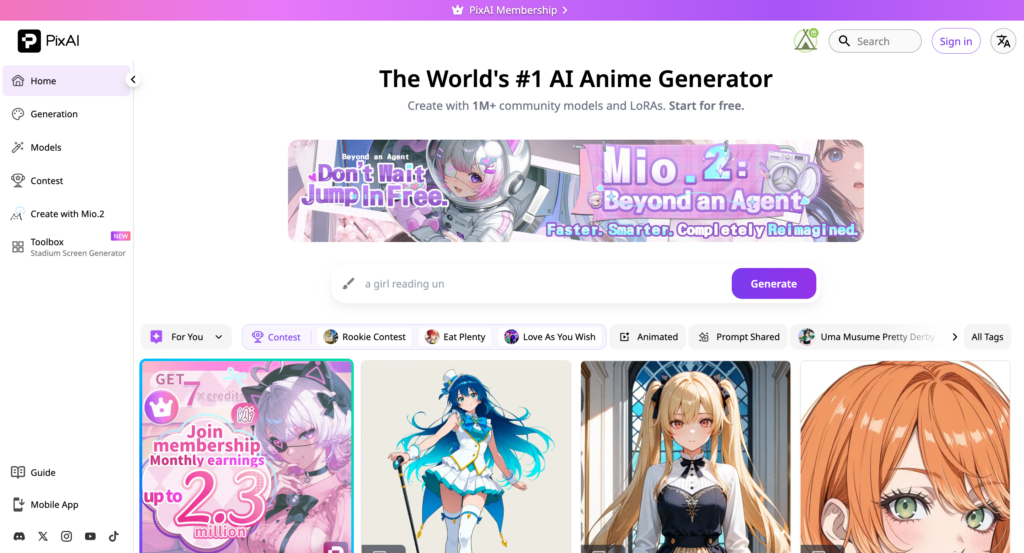
What Is PixAI?
PixAI is an anime-focused AI art generator built by Metanomaly (operating as Mewtant Inc.), a studio registered in Singapore with a listed presence in Menlo Park, California. It launched in December 2022 and, by the company’s own figures, now serves more than 13 million creators, with its heaviest user base in North America and Taiwan. That combination — a real corporate footprint, a multi-year track record, and a large user base — is the first thing worth saying, because in this niche “is it legit” is a fair opening question, and PixAI clears that bar.
What it does is narrower than a general image tool and better for it. Where Midjourney and its Niji sibling chase a broad range of realistic and abstract looks through Discord, PixAI plants its flag firmly in anime, manga, and ACG-style character art, then hands you a community model marketplace and a stack of LoRAs to fine-tune the result. The core loop is text-to-image and image-to-image anime generation, extended by an image-to-video suite, a conversational creation agent called Mio.2, and a set of natural-language editing tools. It runs on the web and through iOS and Android apps — though, as you’ll see, the web version is the real platform and the app is the compromised half.
Key Features
The image engine and the model market
This is the heart of PixAI, and it’s where the platform genuinely shines. Instead of one house style, you pick a base model — Tsubaki.2 is the current best-out-of-the-box option, Haruka and Otome cover the Illustrious-family anime and manga looks, Serin leans Korean-webtoon, and Hinata V2 pushes vivid color and dynamic poses. On top of any base you stack LoRAs: community-trained “packs” that inject a specific character, art style, outfit, or pose. That marketplace is the differentiator. Midjourney doesn’t natively let you do this; PixAI’s whole appeal is that you can go from generic anime to your character in your style by layering the right LoRAs.
In testing, output quality for anime and illustration was consistently high, and character consistency across a session held up well — the same face and outfit survived pose changes and expression swaps far more reliably than I expected. Push it toward photoreal and it wobbles, which matters less than it sounds because, as you’ll read below, realistic NSFW is off the table entirely. There’s also a real-time sketch-to-art mode you can try with no login at all, which is a nice, low-commitment way to see the engine work before you sign up.
Mio.2 — the “chat” that isn’t a companion
If you searched “pixai ai chat” hoping for an AI girlfriend, read this part carefully. PixAI’s chat is Mio.2, a conversational creation agent that launched on April 15, 2026. You talk to it, and it makes art — no prompt engineering required. Ask for “a dark-elf swordfighter, help me flesh out the outfit and weapons,” and it builds the character, then lets you keep going in the same thread for three-view sheets, expression sets, a chibi version, or a trading-card layout, all with consistent proportions. It runs on selectable language-model tiers (Kotone by default, plus Sena and Osaki), and you get 30 free “stamina” per day; chatting is free, and credits are only spent when it actually generates something.
It’s a legitimately useful tool that drops the skill floor to near zero. But it has no persistent persona, no memory of you as a person, and no romantic roleplay. Yes, the platform has template categories with names like “dating-sim CG” and “visual novel,” but those produce assets — they don’t produce a partner who remembers your day. For companionship, this is the wrong address.
Customization and training
Beyond stacking public LoRAs, you can train your own. Paid tiers include free monthly training slots (more on that in pricing), so you can teach the AI your original character or a specific style and reuse it. There are private model slots for models you upload yourself, and the character-design workflow is deep — the kind of thing that actually serves people building a consistent cast for a comic or a VTuber project rather than one-off pretty pictures.
NSFW — the part everyone’s actually asking about
Here’s the honest truth about PixAI and NSFW, because the search terms oversell it. PixAI runs a three-tier content system: Normal (fully SFW, public), Flagged (mild suggestive content like swimwear — visible only to logged-in 18+ users), and Sensitive (explicit anime content, visible only to you, the creator). To generate anything adult, you have to switch on the “Confirm Over 18” setting; leave it off and NSFW generation is simply blocked.
Now the hard limits, and they’re significant:
Realistic and photorealistic NSFW is banned outright. Sensitive tags can’t be used with realistic models, and any realistic explicit image that gets published is removed. The mobile app allows no sensitive content at all — NSFW is a web-only affair. On top of that, an AI moderation filter scans published content and sometimes false-flags perfectly tame art as “Sensitive,” quietly hiding it from public view; users have complained loudly about this “Faulty Sensitive” behavior, and in my own testing a swimsuit image got shunted to private for no obvious reason. And any content that sexualizes or implies minors, real or fictional, results in immediate account termination — a firm line the platform enforces and appeals cannot undo.
So the accurate summary: PixAI does anime-style NSFW, on the web, kept private to your account. It is not an unrestricted porn generator, and it is a world away from a dedicated NSFW companion app.
Video generation
PixAI’s image-to-video (i2v) and text-to-video (t2v) suite is members-only, and it’s one of the better anime motion toolsets I’ve used. The model lineup runs from v2.5 through the v4.0 Preview released in June 2026, and each has a personality: v3.0 emphasizes character consistency and ships with one-click dance presets, v2.7 is the cinematic option with a dedicated camera-movement dropdown, and v2.5 is the flexible one that supports video LoRAs. The v4.0 Preview is the headliner — it added native voice generation in English, Japanese and beyond with lip-sync that actually tracks, cinematic camera control, character references, and ambient audio, music and SFX baked into 5-to-15-second clips. You choose 5- or 10-second durations and a Basic or Professional quality mode. It’s genuinely capable, but it’s fully paywalled and it eats credits, so it’s not something you casually dabble in on the free tier.
Editing tools
Flow Edit and Reference Pro let members change an image with plain language — swap a background, change an outfit, add an element — and there are traditional inpaint and outpaint tools for manual control. The natural-language “image bot” workflow is the standout: describe the change and it applies it. The weak link, echoing a common Reddit gripe, is the character-reference and ControlNet tooling, which occasionally refused to detect a face that was clearly present. It’s usable, but it’s the buggiest corner of the platform.
Hands-On Experience
Onboarding is quick — sign up with Google, Twitter or email, and immediately claim your daily free credits. Do not skip that step; those credits are the fuel, and forgetting to claim them just hobbles you for the day. Verifying your email unlocks a small generation discount, which is a genuine nudge worth taking. My first real generation on a strong base model came back fast and clean, and that set the tone for the image side: on Turbo Mode (paid) results land in seconds, while the free queue at peak times had me waiting a minute-plus, and on mobile that wait sometimes came with an ad prompt to earn more credits.
Credit economics are where reality bites. Single low-resolution generations are cheap enough that the free tier feels generous. Crank up resolution, stack multiple LoRAs, or touch video, and credits drain quickly — this is the mechanism that eventually pushes heavy users toward a subscription. The Mio.2 agent was the pleasant surprise of the test: chatting my way to a consistent character sheet, then iterating on outfits and expressions, worked smoothly and required zero prompt knowledge. The moderation filter was the recurring irritation, over-flagging borderline-innocent art, and the reference tool was the one feature I’d call outright unreliable. Net impression after a few weeks: polished, fast and deep on the art side, with rough edges around moderation and reference tooling that the company is clearly still working on.
Key Takeaways
| Pricing | Free tier: yes (10,000 daily credits + earn-more options). Paid annual-billed: Starter $7.99/mo, Plus $22.99/mo, Premium $35.99/mo (monthly billing runs higher) |
| Customization | Deep — community model market, stackable LoRAs, custom LoRA training, private model slots, character-consistency tools |
| AI Performance | Multiple anime base models (Tsubaki.2, Haruka, Otome, Serin, Hinata V2) + LoRAs; Mio.2 conversational agent; i2v/t2v video up to v4.0 Preview |
| Privacy & Security | Card handling via third-party processor; sensitive art private by default; self-serve deletion with 30-day restore; mobile app runs an ad SDK |
| Platform | Web (full features), iOS and Android (restricted — no NSFW, ad-supported) |
Pricing & Plans
PixAI’s free plan is unusually generous and, crucially, not a crippled demo. You get 10,000 daily login credits just for showing up, plus credits for publishing artwork (up to 10,000 a day), sharing to social platforms, and referrals — the permanent referral program gives you and a friend 20,000 credits each, with no cap on invites. Consistent free users can accumulate large daily totals, and unused credits don’t expire; they roll over indefinitely. For anyone who only generates occasionally, the free tier is genuinely enough.
The paid tiers, billed annually and shown here as monthly-equivalent prices, break down like this. Starter ($7.99/mo) adds 300,000 monthly credits, a 20% daily bonus, unlimited Turbo Mode, the full video suite, Flow Edit, three free LoRA trainings a month, up to five LoRAs per generation, and 15 private model slots. Plus ($22.99/mo) steps up to 1,000,000 monthly credits, a 100% daily bonus, Professional video mode, five trainings, ten LoRAs per task, and 25 slots. Premium ($35.99/mo) tops out at 2,000,000 monthly credits, a 200% daily bonus, a 150% top-up bonus, ten trainings, 15 LoRAs per task, and 35 slots. If you see older figures floating around — $9.99, $29.99, $49.99 — those reflect the monthly-billing rates or previous pricing; the annual commitment is meaningfully cheaper, and PixAI runs seasonal sales, so the discount rate fluctuates. On top of subscriptions you can buy one-time credit packs, with members getting bonus credits on every purchase.
Now the honest part, because this is where PixAI collects most of its complaints. Video and Flow Edit are entirely behind the paywall — the free tier cannot animate anything. There’s a persistent web-versus-app price gap: the app charges more than the website for the same product because of Apple and Google platform fees, with users reporting figures like roughly $9.90 on web versus $11.99 in the app. Worse, credit and debit cards frequently fail on the website, which pushes people onto the pricier app to complete a purchase — a documented, recurring frustration that PixAI hasn’t fully resolved. And auto-renewal is on by default; the terms renew your subscription unless you cancel roughly 30 days before the term ends, and Trustpilot carries a pattern of users reporting surprise annual charges of $200 or more they say they didn’t knowingly select. Read the checkout screen carefully before you commit.
Cancellation is straightforward but platform-specific: you manage your plan wherever you bought it. On web, that’s Profile → Membership & Credits → Manage Auto-Renew; on mobile, it’s the App Store or Google Play subscriptions screen. Your benefits run to the end of the paid period. Refunds on mobile go through Apple’s or Google’s policies rather than PixAI directly, so don’t expect a generous no-questions refund — this is a “know what you’re buying” platform.
Privacy & Security
For a niche where the fear of exposure is real, PixAI sits in a reasonable middle. It collects the usual account data — name, email, payment details — plus usage data, and it states it does not process sensitive personal information in the legal sense. Credit card processing is handled by a third-party intermediary that isn’t permitted to store your billing details beyond processing the transaction. On the content side, anything you generate as Sensitive is private to your account by default and can be blurred, which is the right posture for adult work.
The privacy wrinkle is the mobile app, which runs the AppLovin advertising SDK and collects device identifiers, usage data and ad-interaction events, and the platform shares de-identified usage data with advertising and marketing partners. The web experience is cleaner. If privacy is a priority, use the web version and skip the ad-watching credit path entirely.
On billing discretion: mobile purchases bill through Apple or Google and show generic store descriptors, which is about as discreet as it gets. Web purchases run through a standard card processor, and I couldn’t confirm the exact string that appears on a bank statement — so if a specific descriptor matters to you, test with a small credit pack first rather than trusting a promise I can’t verify. That said, PixAI presents as an anime-art platform, not an adult-branded site, so the exposure is inherently lower than a dedicated NSFW app.
Deletion is real and self-serve. On web it’s Settings → Misc → Delete Your Account; on the app it’s Me → Profile → Account → Delete Account, with a 30-day recovery window (restoration only works on web). You have to cancel any active subscription first — you can’t delete an account with a live membership. One caveat the platform states plainly: some content or cached data may linger, and published work can remain indexed by search engines even after deletion, so set anything sensitive to private and delete it before you close the account.
Pros & Cons
Pros:
- The deepest anime model and LoRA ecosystem I tested, with character consistency that genuinely holds across a session — the reason serious character artists gravitate here.
- A free tier that punches well above its price: daily credits plus publishing, sharing and referral credits let you create a lot without paying, and credits never expire.
- Fast on Turbo Mode, and the video suite — especially the v4.0 Preview with native voice, lip-sync and camera control — is one of the better anime image-to-video toolsets available.
- The Mio.2 agent lowers the skill floor to nothing; you can chat your way to strong, consistent results with zero prompt knowledge.
Cons:
- NSFW is far narrower than the search hype: anime-only, web-only, kept private, and policed by an AI filter that over-flags innocuous art. Realistic and photoreal NSFW are banned entirely.
- It is not a companion — no persistent persona, no memory, no romantic roleplay. Anyone arriving for an AI girlfriend will be disappointed.
- Billing has a real complaint trail: web-versus-app price gaps, cards failing on web, and auto-renew charges (including reports of $200-plus annual hits) users say they didn’t knowingly choose.
- Reference and ControlNet tools are buggy, credit burn on high-res, multi-LoRA and video work is steep, and the mobile app is both ad-supported and content-restricted.
Alternatives / Comparison
If what you actually want is an AI girlfriend, Candy AI is the category PixAI doesn’t play in — persistent chat, voice, image generation, and companion personas across both realistic and anime styles. Go there for a relationship; come to PixAI for art. For looser NSFW image generation, Promptchan is the closest functional swap: it uses pay-per-generation pricing, permits realistic output, and carries fewer content restrictions, which makes it the better call if uncensored or photoreal adult imagery is the goal.
On the pure art side, NovelAI offers polished anime image generation with fewer NSFW hang-ups behind a flat subscription, while Civitai gives you the widest open model and LoRA hub — including plenty of NSFW — if maximum model choice matters more than a clean interface. And if you want the highest-end anime polish with no NSFW at all, Niji still edges PixAI on raw aesthetic refinement, though it gives you no LoRA marketplace and no adult content.
PixAI wins when your priority is anime-first art with a huge community model library, custom character training, and a capable video suite, all at a low free-to-start cost. A competitor wins when your priority is companionship (Candy AI), uncensored or realistic NSFW (Promptchan or Civitai), or top-tier illustration polish (Niji).
Who It’s For / Not For
PixAI is for anime and manga artists, character and OC designers, VTuber and asset creators, and hobbyists who want to make a lot of anime art without spending much — and it’s for people who specifically want anime-style adult art they’ll keep private and use elsewhere, and who are fine doing that on the web. It rewards anyone willing to learn the model-and-LoRA workflow, and the Mio.2 agent means even total beginners can get good results.
It’s not for anyone who wants a talk-to-me AI girlfriend or companion; that’s simply not what this is. It’s not for anyone whose main goal is realistic or photorealistic NSFW, which is banned. It’s not for people who want a pure mobile experience, since the app is the weaker, content-restricted, ad-supported half. And it’s not for anyone who won’t keep an eye on an annual auto-renew.
FAQ
Is PixAI safe and legit?
Yes. It’s run by a real company with a multi-year track record and, by its own count, over 13 million users, with self-serve account deletion and card data handled by a dedicated processor. The legitimate concerns are the billing complaints and the ad SDK in the mobile app, not scam behavior. Treat the checkout screen and auto-renewal with care and you’ll be fine.
Is there a free version?
Yes, and it’s genuinely usable rather than a teaser. You get 10,000 login credits a day, plus more from publishing, sharing and referrals — enough to generate a lot of images without paying. The main features locked behind a subscription are video generation and the Flow Edit natural-language editor.
How much does PixAI really cost?
It’s free to start. Paid annual-billed tiers run $7.99 (Starter), $22.99 (Plus) and $35.99 (Premium) per month, with monthly billing costing more. Two things to watch: the app charges more than the website for the same plan, and annual auto-renew has hit some users with charges of $200 or more they didn’t expect.
Does PixAI do NSFW?
Anime-style NSFW, yes — on the web, with the 18+ setting enabled, and kept private to your account. Realistic and photorealistic NSFW are banned, and the mobile app blocks sensitive content entirely. The AI moderation filter also over-flags, so expect the occasional false positive on tame art.
Is the PixAI “chat” an AI girlfriend?
No. The chat is Mio.2, a creation agent that builds images and visual stories from conversation. It has no persistent persona, no memory of you, and no romantic roleplay. If companionship is what you’re after, PixAI is the wrong tool.
How realistic are the images?
Excellent for anime and illustration, and character consistency across a session is a real strength. It’s middling at photoreal — and since realistic NSFW is prohibited, you won’t be getting photoreal adult output from it at all.
Can I delete my data?
Yes. Use Settings → Misc → Delete Account on web, or Me → Profile → Account on the app, with a 30-day window to restore. Cancel any active subscription first. Note that some content and cached data can persist, and published work may stay indexed by search engines, so set sensitive art to private and remove it before closing the account.
Are PixAI codes a real thing?
Mostly referral codes — you and a friend each earn credits when they sign up, through a permanent program with no cap on invites. Genuine discount coupons are rare; most “90% off PixAI” coupon sites are junk. The reliable ways to earn free credits are daily check-ins, publishing your work, and referrals.
Final Verdict
PixAI earns its 8/10 as an anime art platform — a deep model library, strong character work, a capable video suite, and a free tier that outperforms its price. But it’s a studio, not a soulmate. The NSFW reality is narrower than the search terms imply, being anime-only, web-only and filter-policed; the “chat” is a creation agent rather than a companion; and the billing deserves a careful eye before you sign up for an annual plan. If you want to make anime characters — spicy or otherwise — and take them wherever you like, subscribe on the web and enjoy one of the best tools in its lane. If you came looking for an AI girlfriend, this isn’t the one.