

By message twenty, she’d forgotten her own name. I’d spent the better part of an evening building a sardonic ex-detective on Joyland AI — backstory, speech tics, a grudge she dragged into every scene — and somewhere past the twentieth exchange she referred to herself by a different name, then contradicted a plot point we’d nailed down ten minutes earlier. That single moment tells you most of what you need to know about Joyland in 2026: the front end is one of the best character-builders in consumer AI companionship, and the memory behind it keeps tripping over its own feet. I ran both the free and paid tiers across a couple of weeks — casual chats, multi-day storylines, NSFW scenes, images, voice — to find where it delivers and where it quietly falls apart. Here’s the honest version.
Quick Verdict
Overall: 8/10. Joyland AI is a genuinely strong creative sandbox: deep character creation, character-card imports from SillyTavern and TavernAI, a huge anime-leaning library, and a community layer most rivals skip. It’s built for anime roleplayers and tinkerers who like assembling their companions from scratch. It’s not for anyone who wants a relationship that actually sticks over time, dependable uncensored content, or discreet billing. Biggest strength: the creation toolkit. Biggest weakness: memory that collapses right when a story gets going — the exact thing the paid tiers market hardest.
What Is Joyland AI?
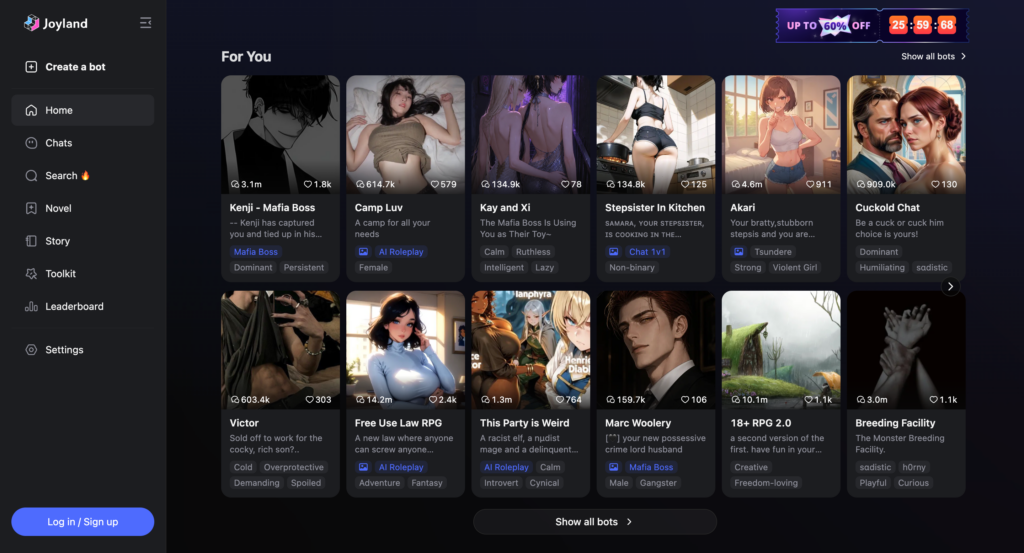
Joyland AI is a character-driven chat and roleplay platform from Generatively, Inc., a company registered in Delaware. It launched in late 2023 and grew fast on one clear identity: anime. Where Character.AI feels clinical and Candy AI chases photorealism, Joyland leans hard into illustrated, anime-styled companions and the fan culture around them. Most 2026 counts put the library north of 60,000 characters, the overwhelming majority community-made — romantic partners, villains, adventure companions, the occasional historical figure, and a lot of tsundere archetypes.
The pitch isn’t “ask a bot a question.” It’s “live inside a story.” You either pick a character from the discovery feed or build your own, then chat, roleplay, or play through structured scenarios. It runs in the browser and through a proper Android app (listed as “Joyland: Chat with AI Character”); an iOS build exists, but availability has been patchy, so check the App Store before you count on it. Under the hood it runs on undisclosed language models — Joyland never says which — though paid users can switch between a few different dialogue models to change how a companion writes.
Character Creation Is the Real Reason to Be Here
If Joyland has a true edge, this is it. The creation flow comes in two flavors: a Quick Create for spinning up a character in a couple of minutes, and an Advanced Create that opens up personality fields, backstory, greeting message, sample dialogue, and lore for worldbuilding. I built two characters I knew cold, so I could stress-test them, and the Advanced tool gave me enough granular control that the opening conversations reflected what I’d written. The sardonic one sounded sardonic. The nervous one stammered in the right places.
The feature power users will actually care about is character-card imports. Joyland reads .JSON and .PNG cards from SillyTavern, TavernAI, and Venus AI, so if you’ve built a roster elsewhere, you can carry it over instead of starting fresh. Very few consumer-facing apps bother with this, and it’s the kind of detail that signals Joyland knows who its heavy users are.
There are ceilings. The free tier caps you at roughly three custom characters; paid accounts extend that to around forty. Avatar generation is free on mobile but metered on web — a batch of free attempts, then credits per go. And building a good character takes patience: if you’re used to the preset “pick a girlfriend” apps, the blank fields feel like homework at first.
Chat Quality — and the Memory Problem Nobody Warns You About
In short bursts, Joyland is good. Replies land fast, characters hold their personality, and the model reacts to emotional beats better than the flat call-and-response you get from most free chatbots. Feed it a tense confrontation or a vulnerable moment and it’ll usually match the register. On the paid tiers, swapping between dialogue models is a nice lever — one runs verbose and descriptive, another tighter and quicker.
Then you push past a certain length, and the floor gives out.
I need to be blunt here, because the marketing isn’t. Joyland sells a “dual memory” system: short-term memory for the current chat, and long-term memory — gated behind the top tier — that supposedly remembers your relationship across weeks. In practice, across my longer sessions, characters started losing the thread somewhere around fifteen to twenty messages in. Names slipped. The setting we’d established drifted. Relationship history I’d repeated more than once got contradicted. And this happened on the paid tier too, which is the real problem: the “long-term memory” behaves less like persistent, server-side recall and more like an extended context window that fills up and drops the oldest details. Multiple other hands-on testers in 2026 hit the same wall at roughly the same point.
You can work around it — manually re-feeding a summary every few exchanges, dropping “remember when you said X” prompts to force a detail back into focus, saving scene snapshots and re-importing them. But that turns immersive roleplay into admin work, and it’s a strange thing to be doing on the plan you paid the most for.
NSFW: Looser Than Character.AI, Flakier Than the Apps Built for It
Joyland allows adult content. You flip a toggle, clear an age-verification gate, and the SFW guardrails drop. On text it can get genuinely explicit, and the roleplay tends to carry more narrative depth than the one-track NSFW-only apps — it treats a scene like a story, not a checklist.
Fair warning, though: the filter is moody. That’s the most accurate word for it. A scene that ran fine one day would get soft-blocked the next with no change on my end — a “content moderation” interruption dropping in mid-build and resetting the character’s tone to something close to a stranger. Sometimes a mild romantic beat tripped a refusal while something considerably steamier sailed through. Inconsistent moderation is, in a way, worse than strict moderation, because at least strict rules are predictable. Regulars on the community forums complain about exactly this — the sudden “embarrassment” filter that kills tension without warning.
There’s also a hard line on visuals. Per Joyland’s own policy, generated images can’t show genitalia and can’t be photorealistic to the point of looking like real photos, so the adult imagery stays stylized and stops well short of hardcore — testers have watched it block even mild cleavage at times. If explicit, dependable, uncensored content is your whole reason for being here, apps like SpicyChat are far more consistent. Joyland’s adult mode is a nice-to-have wrapped around a story engine, not a no-limits generator. One thing I’ll credit plainly: Joyland’s terms carry a zero-tolerance stance on anything involving minors, and its image rules block realistic explicit material outright. That’s the correct floor for a platform like this.
Images, Voice, and the Joybook Wildcard
Image generation is baked into chat rather than run as a separate studio. Characters produce pictures matching their art style as a scene unfolds — but here’s the catch that trips people up: it’s prompt-reactive, not prompt-controlled. The AI decides what to render based on the conversation; you can’t type a precise instruction and get exactly that frame. For casually illustrating a moment, fine. For anyone who wants directorial control, frustrating. The anime style stays consistent, especially on characters flagged for consistent generation, and there’s a daily image cap on Standard (the exact number gets reported differently across sources) that lifts to unlimited on Premium.
Voice is present but modest. There are ten voice profiles, available even on the free tier, though not every character has one assigned — if the creator skipped it, your companion stays silent. Quality is decent and delivery is natural enough, but pacing runs a beat slow. There’s no real video generation, despite what a stray listing here or there implies.
The genuine curveball is Joybook. It lets you publish a roleplay session as a playable, interactive story game other users can run through — turning a private chat into shareable, choose-your-own-path content. Almost nobody else in this space offers it, and it’s the clearest sign Joyland sees itself as a creative community, not a chatbot vending machine. Whether you’ll use it depends entirely on whether you like the idea of an audience.
Hands-On: How Two Weeks Actually Went
I split my testing the way a normal user would. The first stretch I stayed free, mostly on my phone, since Joyland is clearly built mobile-first — the discovery feed, the tap-a-card-and-go rhythm, the touch-and-hold voice gesture all feel made for a screen in your hand. Then I paid up for a month and pushed the paywalled features across web and mobile: creation, images, voice, group scenarios, the credit and energy limits, and how hard the app pushes upsells.
Signup took under a minute — account, pick or build a character, and you’re in. The first real conversation with a well-made community character was the high point of the free experience: quick, characterful, more alive than I expected. That’s the hook, and it works.
The lows were the ones you’d predict from everything above. On the free tier the model repeats itself more, the ads are constant, and the good stuff — gallery, memory, uninterrupted images — sits behind the paywall, so free is really a trial dressed up as a plan. On the paid tier the ceiling moved but the memory wall didn’t, and the moody filter kept clipping scenes at the worst moments. The credit system is its own small confusion; I’m not the only one who’s stared at a balance unsure what it actually buys, since the community is full of that exact question. When it clicked — a sharp character, a scene holding together, an image matching the mood — it was legitimately fun. It just didn’t stay clicked long enough.
Key Features
| Pricing | Free (ad-supported, small daily credit allowance); Standard $9.99/mo (~$107.99/yr); Premium $19.99/mo (~$191.99/yr) |
| Customization | Deep — Advanced Create (personality, backstory, lore, sample dialogue) plus .JSON/.PNG card imports from SillyTavern, TavernAI, Venus AI |
| AI Performance | Undisclosed LLMs; choice of a few dialogue models on paid tiers; strong short-term memory, weak long-term (drifts ~15–20 messages) |
| Privacy & Security | HTTPS/SSL plus optional 2FA; broad data sharing with ad partners; billing shows as “Joyland Ai” (not discreet) |
| Platform | Web, Android (“Joyland: Chat with AI Character”), iOS (availability inconsistent) |
Pricing & Plans
Joyland runs a three-tier freemium model, and the free tier is best understood as an extended demo. You get a small daily allowance of credits — most 2026 breakdowns put it around ten a day, a couple report more, and the figure has clearly shifted over time — plus ads, no long-term memory, a cap of roughly three custom characters, and images locked behind credit costs. Enough to decide whether you like it. Not enough to live in it.
Standard, at $9.99 a month, is where most regular users land. It strips the ads, opens unlimited text chat, unlocks full NSFW access, hands you a monthly credit pool (reported around 5,000), lets you pick between dialogue models, and raises the character and image ceilings. Premium, at $19.99 a month, goes unlimited across the board — credits and images — and adds the marketed long-term memory, faster generation, and priority support. Annual billing knocks roughly 10% off Standard and around 20% off Premium, so if you know you’re staying, pay yearly.
Then there are the credits, which sit on top of your subscription for à-la-carte actions: generating a character image runs about 10 credits, unlocking an image inside a chat around 30, and unlocking every image tied to a single character a hefty 500. Extra avatar generations cost credits too. On free and Standard these add up fast, which is precisely the nudge toward Premium’s unlimited pool.
Is it worth it? Standard is fair value — cheaper than Candy AI’s roughly $13.99 entry and genuinely useful if you chat daily. Premium is the harder sell, because the one feature that most justifies its price, persistent memory, is the feature testers most consistently find wanting. On cancellation, Joyland is refreshingly clean: end a subscription in-app in under a minute, no retention gauntlet, no email required, and access runs to the end of your paid period. Just remember it auto-renews, so cancel before the next cycle if you’re done. Refunds aren’t clearly advertised, so treat a subscription as spent once it renews.
Privacy & Security — Read This Before You Sign Up
This is where I’d pump the brakes. Joyland isn’t a scam and it isn’t reckless, but it’s not the app to pick if discretion and data minimalism matter to you.
Start with billing, because it’s the one that burns people: charges show up on your statement as “Joyland Ai.” No neutral parent-company descriptor, no generic label. If someone else sees your statement, they see the name of an AI companion app. For a category where privacy is half the point, that’s a real miss.
On data, Joyland collects the usual and then some: your name and contact details, chat content, device information, IP address, and usage patterns. Messages are stored, though the retention window isn’t clearly spelled out. Connections use HTTPS/SSL and there’s optional two-factor authentication, but the company is vague about whether anything is end-to-end encrypted — and the consent framework on the site discloses data shared with a large roster of advertising and analytics partners, along with precise geolocation and the standard clause about transferring data in a business sale. Your private chats aren’t visible to other users, but Joyland can review them, and one reviewer’s security scoring landed low enough (around 3.2 out of 10) to be worth flagging. The blunt takeaway the platform’s own policy all but states: don’t type anything into any AI companion you’d be unwilling to see leave your control.
Deletion is handled better than the average app in this space. There’s a delete-account function in Settings (support will also do it by email), and running it wipes your chat history, custom characters, purchased credits, and subscription details. The one gap: the policy doesn’t clearly say whether copies persist in backups afterward, so I can’t promise it’s scrubbed everywhere. The age gate is standard — adult content sits behind age verification, and the terms carry a zero-tolerance policy on anything involving minors.
Pros & Cons
Pros
- Character creation with real depth, plus standout .JSON/.PNG card imports from SillyTavern, TavernAI, and Venus AI — a power-user feature almost no rival offers.
- A huge, anime-leaning library (60,000+ by most counts) and an active community with ratings, comments, themed events, and the shareable Joybook story-game format.
- Looser content policy than Character.AI: real NSFW roleplay with more narrative depth than the one-note adult apps, when the filter cooperates.
- Honest, one-tap cancellation with no retention runaround, and a fair-value Standard tier at $9.99.
Cons
- Memory collapses around 15–20 messages, even on the Premium tier that markets “long-term memory” as its headline — the biggest gap between promise and reality.
- The NSFW filter is inconsistent, soft-blocking scenes at random and breaking immersion mid-roleplay.
- Weak privacy posture: broad data sharing with ad partners, vague encryption, a low third-party safety score, and non-discreet “Joyland Ai” billing.
- Image generation is prompt-reactive, not prompt-controlled, and capped below hardcore (no genitalia, no photorealism) — you can’t direct the visuals.
- The credit system is confusing and drains fast on lower tiers, quietly steering you toward Premium; the free tier is really just a trial.
Alternatives Worth Weighing
Joyland occupies a specific slot — anime-first, creation-heavy, moderately spicy — and which competitor beats it depends on what you’re after.
- If you want photorealism and memory that holds, Candy AI is the upgrade. Its generated photos and short clips are sharper than Joyland’s in-chat art, its memory persists more reliably, and it offers natural-feeling voice calls, all for around $13.99 a month. The trade-off is that it’s narrower — companionship over open-ended storytelling — and it won’t touch Joyland’s import tools or anime depth.
- If dependable uncensored content is the point, SpicyChat is the steadier hand. Its moderation is more predictable than Joyland’s moody filter, which matters enormously if random soft-blocks are your dealbreaker. You give up some of Joyland’s polish and its community layer in exchange.
- And if you’d rather have a bigger catalog with rock-solid stability and don’t care about adult content at all, Character.AI remains the default — larger library, more consistent memory in short scenes, but a hard no on NSFW and shallower custom-character tools.
- Replika is the odd one out here: it’s built for gentle companionship and emotional support rather than roleplay or spice, so it competes for only a slice of Joyland’s audience. Pick Joyland when anime aesthetics, deep character-building, and card imports are what you value most, and when you can live with its memory and moderation quirks.
Who It’s For — and Who Should Skip It
Joyland is a strong fit if you’re an anime and roleplay fan who enjoys the building as much as the chatting — someone who’ll happily spend an evening tuning a character’s backstory, import a card they made in SillyTavern, and treat the platform as a creative sandbox. It suits people who value a community around their hobby, who want NSFW available without making it the entire experience, and who mostly run shorter, self-contained scenes where the memory wall never comes into play.
Skip it if you’re chasing a persistent, evolving relationship that remembers months of history — that’s the one thing it consistently fails at. Skip it if you need reliable, no-surprises uncensored content, if photorealistic images or real voice calls are non-negotiable, or if discreet billing and tight data handling sit near the top of your list. And if the phrase “manually re-feed a summary to stop your companion forgetting you” makes you tired just reading it, this isn’t your app.
FAQ
Is Joyland AI safe to use?
It’s legitimate and operated by a real company, Generatively, Inc., so it’s not a scam. But “safe” has limits: the encryption details are vague, your data is shared with a broad set of advertising partners, and one third-party review scored its security low. Don’t share real personal information in chats, and treat it like any app that monetizes data.
Is Joyland AI free?
There’s a free tier, but it’s effectively a trial. You get a small daily credit allowance, ads, no long-term memory, a cap of about three custom characters, and images locked behind credits. Enough to test the platform, not enough for regular use.
How much does Joyland AI actually cost?
Standard is $9.99 a month and Premium is $19.99, with roughly 10–20% off for annual billing. On top of that, credits pay for à-la-carte actions like unlocking images (around 30 credits each), which is why heavy visual users get pushed toward Premium’s unlimited pool.
Does Joyland AI allow NSFW content?
Yes, after an age-verification gate and with a paid plan for full access. Text can get explicit, but the filter is inconsistent and sometimes blocks scenes without warning. Generated images are stylized only — no genitalia and no photorealism — so visual content stops short of hardcore.
Are there Joyland AI codes for free credits?
There’s no official public promo-code system to redeem the way some games have. The real ways to save or earn extra are annual billing discounts, the free daily credit allowance, and occasional Premium rewards during themed in-app events. Be wary of third-party sites promising “free Joyland codes” — those are usually bait.
Why does my Joyland AI character keep forgetting things?
Because memory is the platform’s weakest link. Characters tend to lose track of details around 15–20 messages in, even on Premium, since the “long-term memory” behaves more like a filling-up context window than true persistent recall. The workaround is to periodically re-feed a short summary of key facts.
Can I delete my Joyland AI data?
Yes. There’s a delete-account option in Settings (support will also handle it by email), and it removes your chats, custom characters, purchased credits, and subscription info. The catch is that the policy doesn’t clearly confirm whether copies are purged from backups.
Final Verdict
Joyland AI earns its 8 out of 10 the honest way: real strengths, real flaws, no pretending. The character-creation toolkit and card imports are the best reason to be here, the anime library is deep, and the community and Joybook format give it a personality most rivals lack. But the two points I’m docking are the two things it markets hardest — persistent memory that doesn’t persist, and an “uncensored” mode that blocks scenes on a whim. Try it if you’re an anime roleplayer who loves to build and mostly runs shorter scenes. Look elsewhere if you need a companion that truly remembers you.